Stuck in snow, a ditch or a yard, or just broken down? The difference between winching and towing, and when you need both. Dave's Towing 24/7: 403-272-3944.
When you call for help, one of the first things dispatch needs to know is whether your vehicle can be reached and loaded where it sits. That's the difference between winching and towing. Winching gets a vehicle out of a spot where it's stuck. Towing moves it from one place to another. Many calls need one or the other, and some need both.
Dave's Towing Services has handled winching, recovery and towing in Calgary since 1992, and we're available 24/7. This guide explains how each works so you can describe your situation clearly and get the right help faster.
What Winching Does
A winch is a powered drum with a cable or synthetic line. The operator connects the line to the vehicle and slowly pulls it from a position where it can't drive or be loaded normally. Winching is used when a vehicle is:
- Stuck in deep snow, mud or soft ground
- Partly or fully in a ditch
- Sitting on an angle, a slope or a curb
- In a spot where the truck can't get close, such as a narrow lane or the back of a yard
- Unable to roll because of locked wheels, a seized engine or damage
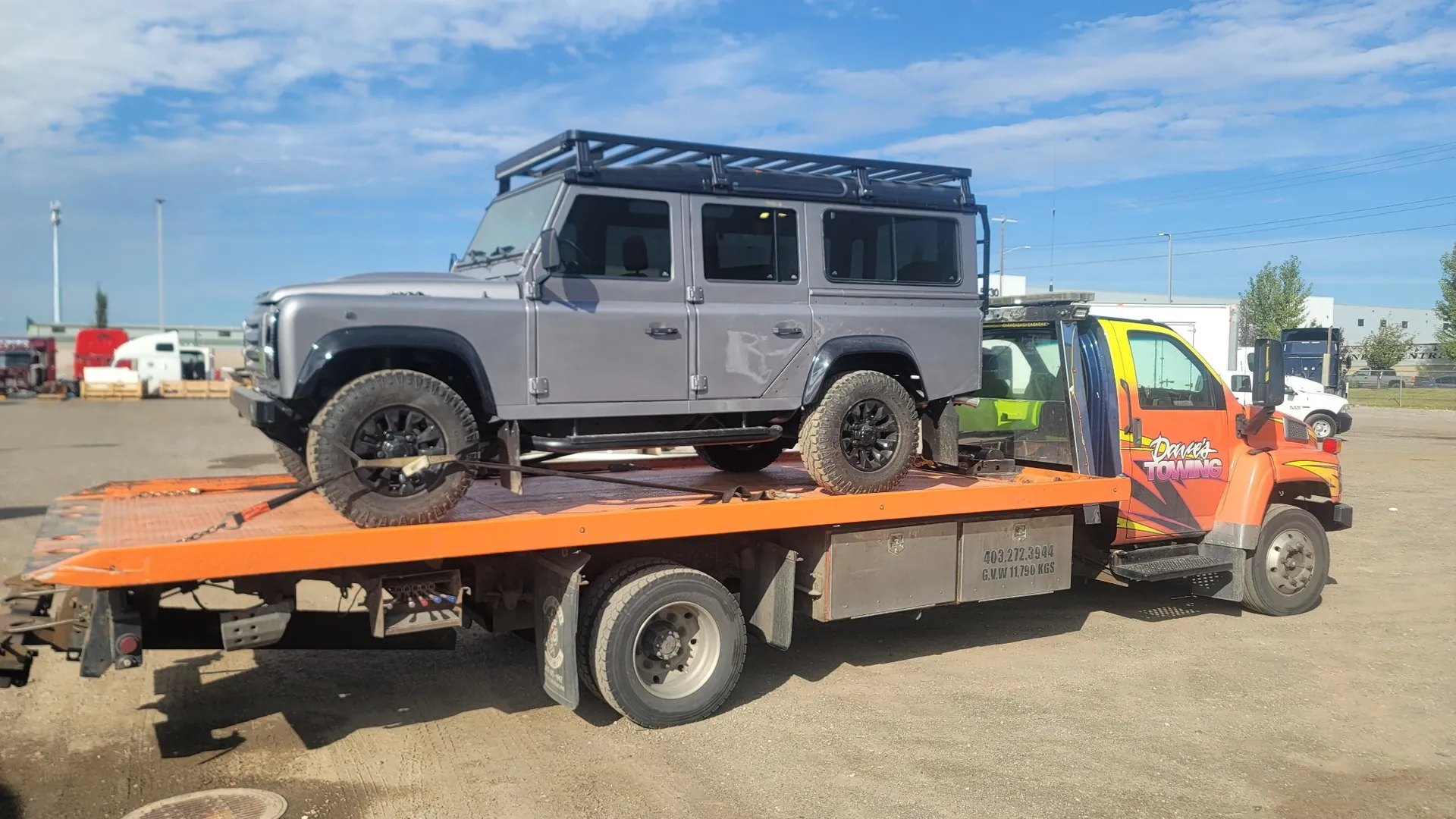
On a rollback flatbed, the winch also pulls a non-running vehicle up the tilted deck. That's how we load cars, trucks and cube vans that can't drive, and it's also how we load non-running construction machines, such as a scissor lift or other compact light- or medium-duty equipment, onto the deck.
What Towing Does
Towing means transporting the vehicle once it's accessible. There are two main methods:
- Flatbed towing. The whole vehicle rides on the deck. This is best for AWD vehicles, EVs, low cars, damaged vehicles and equipment. See flatbed towing.
- Wheel-lift towing. The truck lifts one end of the vehicle by its wheels, and the other end rolls. It's quick and useful in tight spots, and it's a good fit for many two-wheel-drive cars.
When You Need Both
Plenty of calls start as a winch-out and end as a tow:
- A car slides into a ditch on a snowy Stoney Trail ramp. It's winched back to the shoulder, checked, and if it's damaged, loaded and towed to a shop.
- A pickup sinks into a soft acreage driveway in the spring. It's winched to firm ground, and if it still runs, the driver continues on.
- A piece of equipment dies in a job-site corner. It's winched onto the flatbed deck and transported to the yard or a repair shop.
If the vehicle can be driven safely after it's winched out, you may not need a tow at all.
How to Tell Which You Need
Ask yourself:
- Can the vehicle move under its own power? If yes, and it's only stuck, winching may be enough.
- Is it damaged, leaking or showing warning lights? If yes, it probably needs a tow after it's freed. Read our guide to warning lights: drive or tow?
- Could a truck back right up to it on firm ground? If not, expect a winch to be part of the job.
You don't have to figure it out alone. Describe what you see, and dispatch will help decide.
Calgary Conditions That Lead to Winching
- Winter snow and ice. Snow-filled ditches along the ring road and rural roads catch a lot of drivers, especially in the first big snowfall.
- Chinook melt. Fast thaws turn snow into slush and mud, softening shoulders and gravel lots.
- Spring mud. Acreages, construction sites and unpaved lanes around Rocky View County and Foothills County get soft.
- Construction sites. Uneven ground and tight spaces make equipment hard to reach.
Stay Safe While You Wait
- If you're in a ditch and it's safe, stay in your vehicle with your seat belt on and hazards flashing.
- Don't try to rock the vehicle out by spinning the wheels. It can dig it in deeper or overheat the transmission.
- Don't let anyone pull your vehicle with a strap tied to a part that isn't a proper recovery point.
- In winter, keep the exhaust pipe clear of snow if you run the engine for heat.
What to Tell Dispatch
- Where you are, as exactly as possible
- What happened, and how the vehicle is sitting (angle, depth, snow, mud)
- Whether it runs and whether anyone is hurt
- Photos if you can send them
- Where it needs to go if it needs a tow
Learn more on our winching and ditch recovery page.
FAQ
Is winching gentler than towing?
They do different jobs. Done carefully with proper attachment points, winching shouldn't damage the vehicle.
Can you winch a machine that doesn't run onto your truck?
Yes, for light- and medium-duty equipment. Tell us what it is and roughly how much it weighs.
Do you winch vehicles out at night?
Yes. Dave's Towing is available 24/7.
Call Dave's Towing at 403-272-3944, 24/7.